1. The core principle: drone survey is a trust sale, not a discovery sale
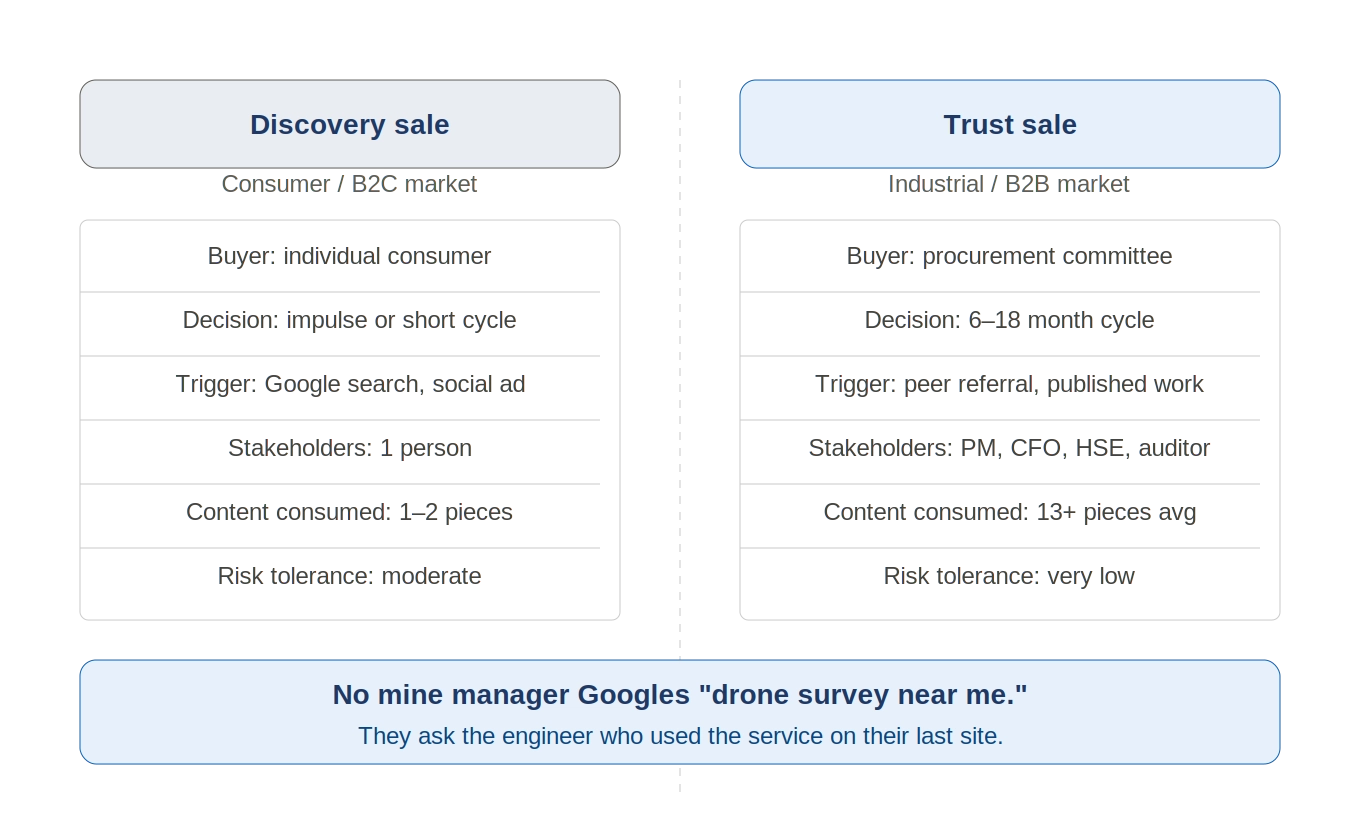
The most important thing to understand about marketing professional drone survey services is that your buyer is not a consumer. A mine manager evaluating a UAV survey contract is not browsing Instagram at 10pm and clicking an ad. They are a procurement decision-maker inside an organisation with a budget cycle, a risk-aversion to unproven contractors, a legal and HSE approval process, and a stack of internal stakeholders — the CFO, the environmental compliance officer, the project engineer, and often the client’s own auditor — all of whom need to be comfortable with the choice before a purchase order is raised.
The average B2B buyer engages with thirteen pieces of content before making a purchasing decision. Eighty-seven percent of B2B transactions take six months or more to complete. Every standard marketing playbook — SEO funnels, paid social, email drip campaigns — is calibrated for consumer buyer behaviour. Industrial procurement operates on a fundamentally different timeline and logic.
2. Your competitive moat is field credibility, not advertising spend
In a market where operators are largely indistinguishable on paper, the only durable competitive advantage is documented operational track record. Evidence means: accuracy certificates from past verified stockpile surveys. Field photographs showing RTK base station deployment at a remote alluvial site. A case study documenting actual RMSE figures from a comparable mine site. A LinkedIn post from three months ago where you walked through how you handled RTK float in forest-clearing terrain. None of that evidence can be fabricated by a competitor who has not been there.
The practical implication: treat every completed mission as a documentation opportunity. Request client permission to use the project (anonymised if required) as a case study. Keep a record of GCP residuals and RMSE figures from every survey. Build a portfolio of accuracy certificates. Photograph your RTK setup at every site.
3. The referral chain: your most efficient client acquisition channel
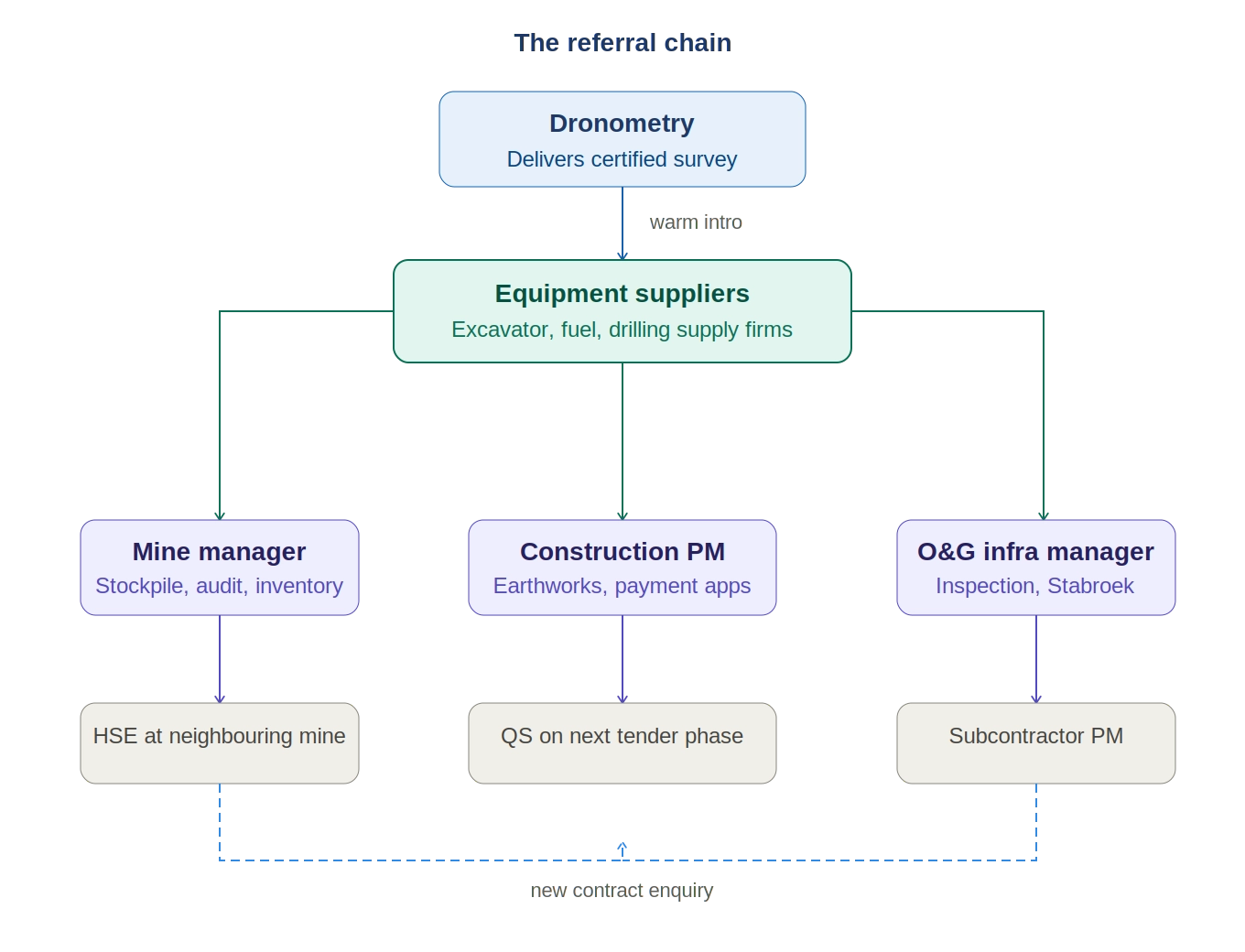
For professional services businesses, client referrals are not just one channel among many. They are the primary channel. A referred client arrives with trust pre-built. They ask fewer questions about credentials, move through procurement faster, and generate on average 16% higher LTV than non-referred clients.
3.1 Mapping the referral chain by sector
In mining, the chain typically runs as follows: a mine manager who receives clean, certified stockpile deliverables on time tells the project engineer or HSE manager at a neighbouring operation. The referral nodes most operators overlook are the equipment and consumables suppliers — the firms that sell excavators, generators, and drilling equipment to mine sites. They are asked constantly for recommendations on service providers and have an established trust relationship with every site manager in the region.
Offer to brief two or three key equipment suppliers’ technical sales teams on what professional UAV survey delivers for their clients — not as a sales call, but as a technical education session. Bring a printed case study. Walk them through an accuracy certificate. When that supplier is next on-site at a mine and the conversation turns to survey, they will make the introduction.
Two well-briefed equipment suppliers are worth more than any trade show budget. They are already in the room every month.
3.2 How to ask for referrals without awkwardness
Three to four weeks after delivering a project, call to confirm the deliverables are performing as expected. Then make the ask directly:
“We’re building our client base in the mining sector and most of our best work comes through introductions from clients who’ve seen the deliverables first-hand. If you know of anyone dealing with the same stockpile measurement challenges, I’d be glad if you’d mention us.”
The follow-up tool is a one-page capability summary PDF — key credentials, two or three case study excerpts, and contact details — that a satisfied client can forward without having to compose a recommendation from scratch.
4. LinkedIn as the professional trust platform
LinkedIn is the only social platform where your actual target audience — mine planners, HSE directors, construction project managers, O&G procurement teams — is present in professional mode and receptive to technical content. 89% of B2B marketers use LinkedIn for lead generation. Thought leadership on LinkedIn establishes credibility with 73% of decision-makers who use it to evaluate potential service partners.
4.1 The personal profile as the primary trust surface
For a solo professional survey operator, the personal profile outperforms a company page. Industrial clients are buying the operator’s judgment and field experience, not a brand. A profile headline that states a specific value proposition — “UAV Survey Operator — Stockpile Volumetrics, Earthworks, Infrastructure Inspection | Guyana” — is a trust document that a company page cannot replicate.
4.2 Content that builds trust without advertising
Content that works: a post documenting how you resolved a specific technical problem in the field — RTK float degradation under partial canopy, managing geoid model uncertainty for vertical deliverables in the Guyana interior, base station positioning in an area with no known control. One substantive technical post per fortnight is enough. Consistency matters more than frequency.
5. The case study as the highest-value marketing asset
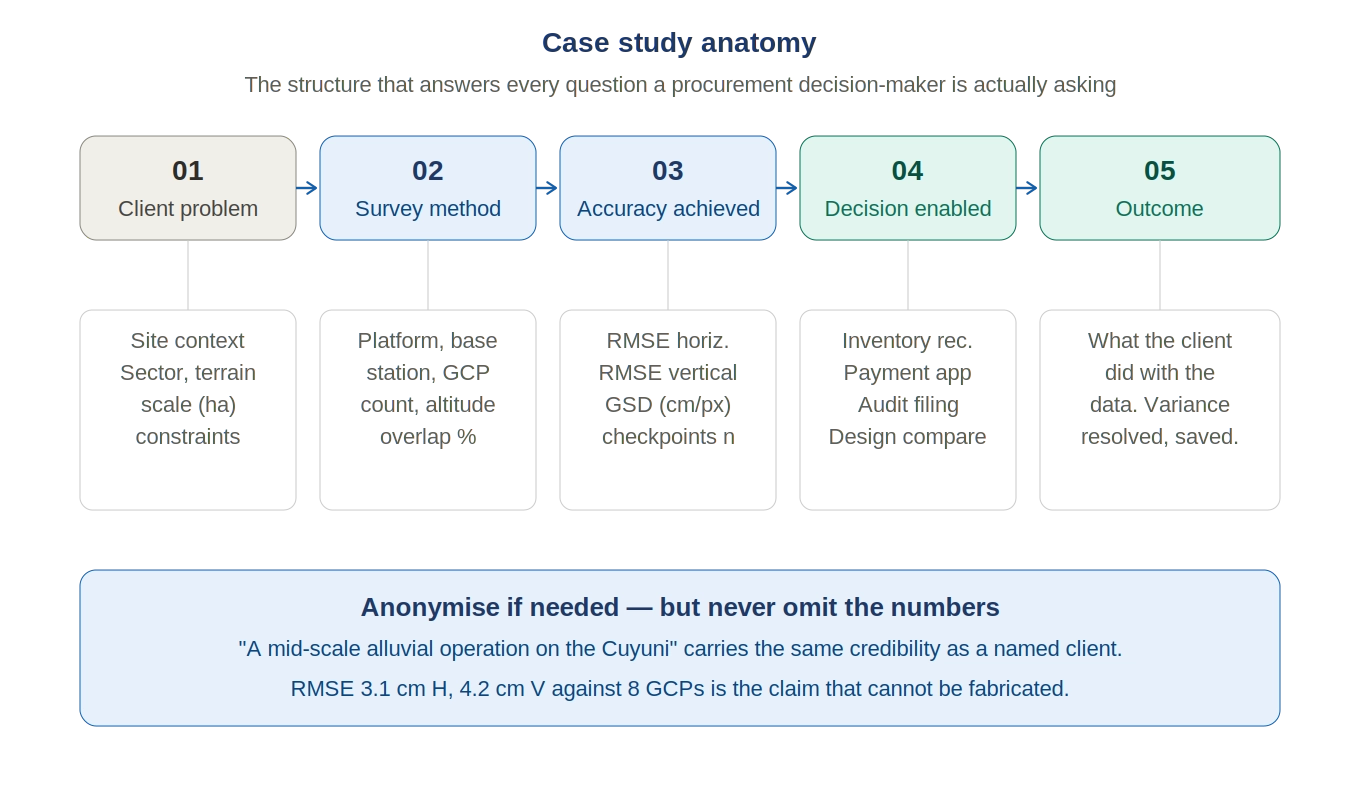
A case study structured as: client problem → survey method → accuracy achieved → client decision enabled → operational outcome is more persuasive than any capability brochure, because it is evidence rather than assertion. Client names should be anonymised unless you have explicit permission — “a mid-scale alluvial gold mining operation on the Cuyuni” conveys the relevant context without identifying the client.
Publish on the Dronometry blog optimised for the search terms a decision-maker in that sector would use. Publish as a LinkedIn article. Keep a print-quality PDF on file to attach to proposals and email follow-ups. Offer a condensed version to industry association newsletters as a contributed article.
6. Industry networking: the meetings that lead to contracts
The Guyana Mining Industry Association (GMIA) is the primary formal networking forum for the mining sector. A fifteen-minute technical presentation on UAV stockpile survey accuracy delivered to mine managers and engineers is worth more in qualified introductions than a year of cold outreach. The Guyana Oil and Gas Association forums bring together infrastructure inspection professionals from the Stabroek Block ecosystem. The chamber of commerce construction forums reach the project managers and civil engineers who make earthworks survey procurement decisions.
7. Direct outreach: the cold introduction done correctly
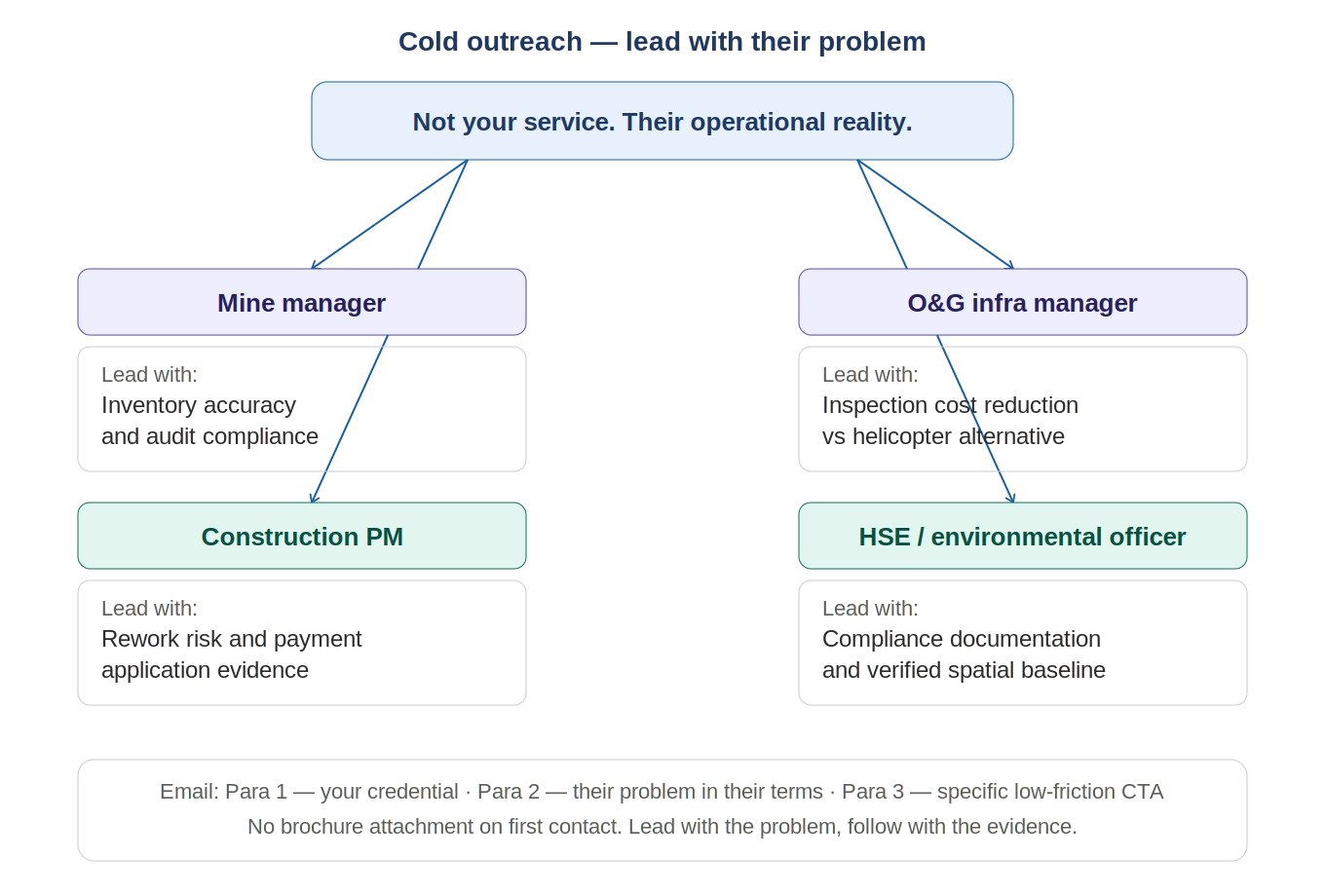
Cold outreach works when it leads with their problem, not your service. Not “RTK-enabled drone survey with sub-5cm accuracy” but “survey methodology that eliminates the three-day ground crew mobilisation for your next quarterly inventory.”
| Role | Lead with | Frame |
|---|---|---|
| Mine manager | Inventory accuracy & audit compliance | “Our volumetric survey has been validated against independent GNSS rover measurement on active Guyana mine sites — I can share the accuracy certificates if you’re dealing with inventory reconciliation pressure at your next audit.” |
| Construction PM | Rework risk & payment application | “A certified survey deliverable before and after each earthworks lift eliminates the volume disputes that delay payment applications.” |
| O&G infra manager | Inspection cost vs helicopter | “A single UAV deployment replaces the helicopter charter and compresses the inspection-to-report timeline significantly.” |
| HSE / environmental | Compliance documentation | “Time-series orthomosaic data gives your environmental compliance reporting a verified spatial baseline that aerial photography cannot match.” |
A cold email should be three paragraphs maximum. Para 1: your specific operational credential. Para 2: their operational problem in their terms. Para 3: a specific, low-friction call to action. No brochure attachment on first contact — that signals you are broadcasting to a list. Follow up every four to six weeks with a new piece of relevant content, not a repetition of the original message.
8. The proposal as a marketing document
Most operators send a rate sheet. A rate sheet answers one question: how much does it cost? A proposal answers the questions the decision-maker needs answered before they can take it to their finance team and HSE department. A proposal that educates the client on professional survey standards positions you as a peer professional, not a vendor competing on price.
- Project scope summary demonstrating you understand the specific site context and operational objectives
- GNSS methodology section explaining base station setup, GCP placement, and accuracy assurance in accessible language
- Reference to past certified deliverables as evidence of the standard you are proposing to meet
- Deliverable formats and integration with the client’s existing GIS or reporting tools
- Turnaround timeline from flight day to final delivery
- Audit and payment application paragraph — what accuracy certification means for the client’s downstream process. This is often the decisive element.
9. The Dronometry blog as a compounding marketing asset
Every article published on Dronometry serves two audiences simultaneously: the professional drone operator readership that drives affiliate marketing revenue, and the industrial decision-maker researching a specific operational problem. A construction project manager who Googles “drone survey earthworks cut-fill accuracy Guyana” and lands on the earthworks article arrives pre-educated and pre-disposed to trust the operator who wrote it. The first contact starts two steps ahead of where cold outreach begins.
10. Putting it together: the trust infrastructure
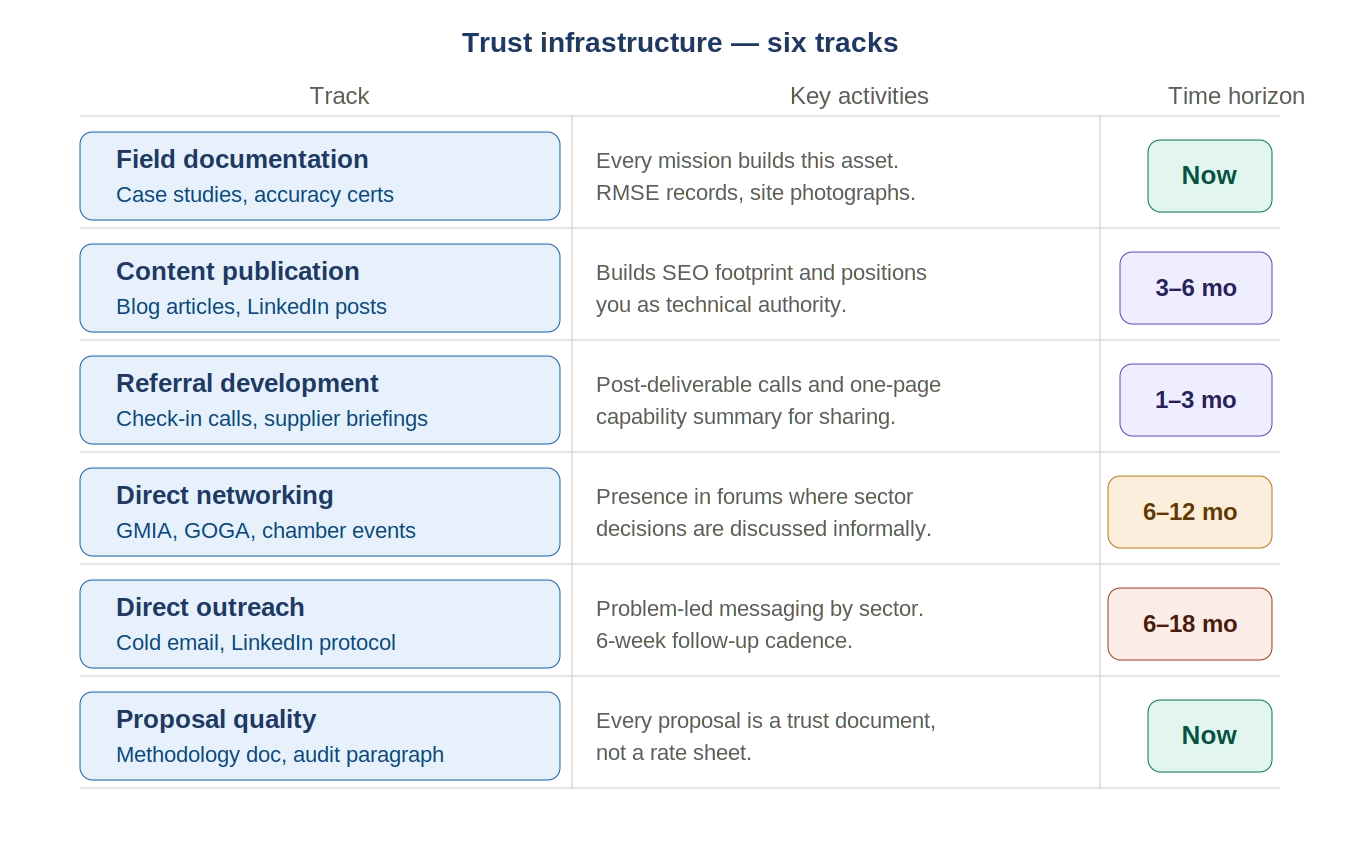
| Track | Key activities | Time horizon |
|---|---|---|
| Field documentation | Case studies, accuracy certs, RMSE records, site photographs — every mission | Start now |
| Content publication | Blog articles, LinkedIn technical posts, newsletter contributions | 3–6 months |
| Referral development | Post-deliverable check-in calls, capability PDF, supplier briefings | 1–3 months per relationship |
| Direct networking | GMIA events, GOGA forums, chamber construction meetings | 6–12 months |
| Direct outreach | Sector cold email, LinkedIn protocol, 6-week follow-up cadence | 6–18 month sales cycle |
| Proposal quality | Methodology doc, certified deliverable refs, audit paragraph | Start now — every proposal |