1. First impressions and exterior build
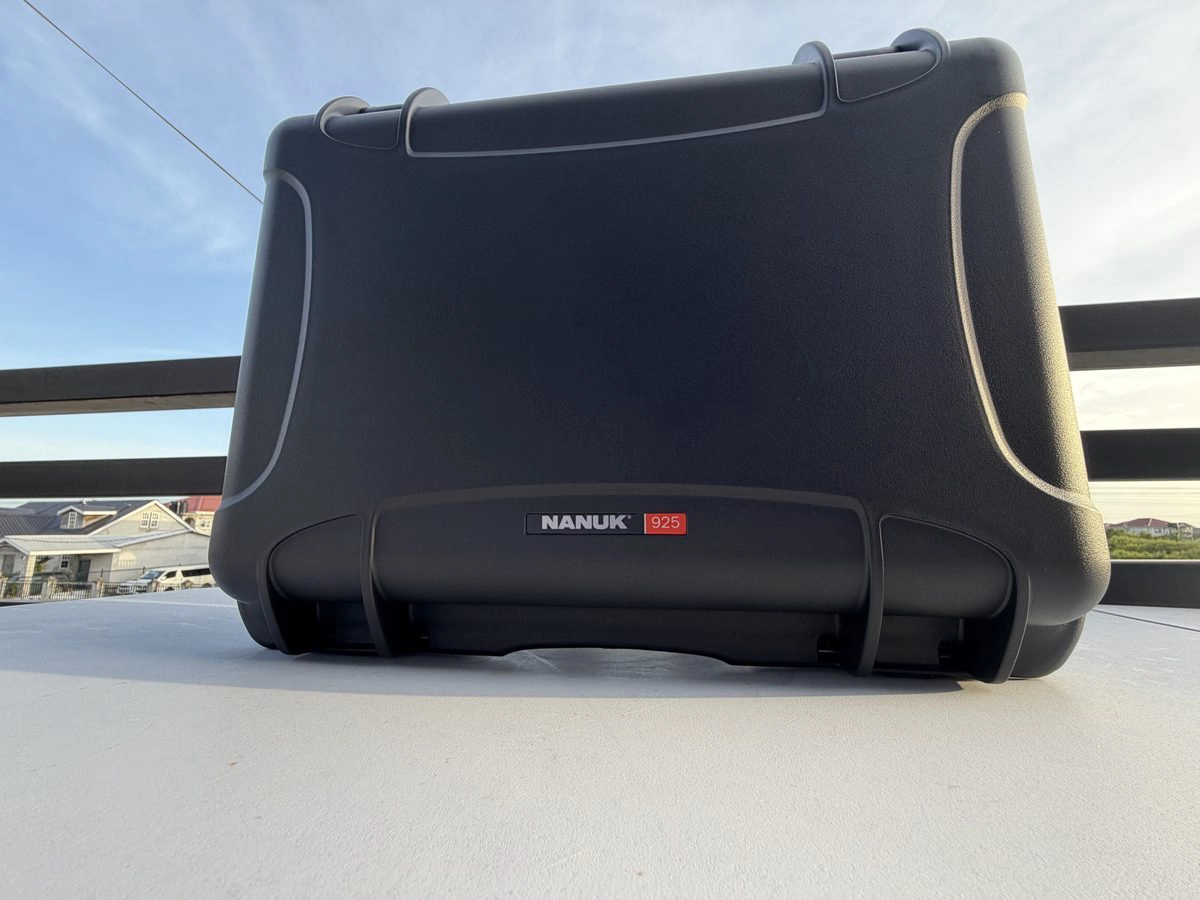
The 925 sits in Nanuk’s mid-range lineup — a case sized for compact professional equipment rather than full-size camera systems or large enterprise drones. Exterior dimensions are approximately 394 × 296 × 151 mm. It is carry-on compliant and genuinely hand-portable without shoulder strain, even loaded.
The shell material is NK-7, Nanuk’s proprietary high-impact polypropylene copolymer blend. What this means in practice is a shell that feels substantially more rigid than the thin ABS you find on generic hard cases, with a surface texture that is matte and slightly tactile rather than smooth and shiny. The texture is functional, not decorative — it provides grip when the case is wet and resists surface scratching in a way that smooth shells do not. After field use, the exterior accumulates minor surface marks that wipe clean; it does not retain deep scuffs the way cheaper plastics do.
The corners are overmoulded with a softer rubber compound — visible as the lighter-toned ribbed sections in the photos. These are genuine impact zones, not aesthetic detailing. Drop a hard case corner-first and that is exactly where the energy concentrates, and Nanuk has engineered accordingly. The overall form is clean and purposeful without looking consumer.
2. The latch system
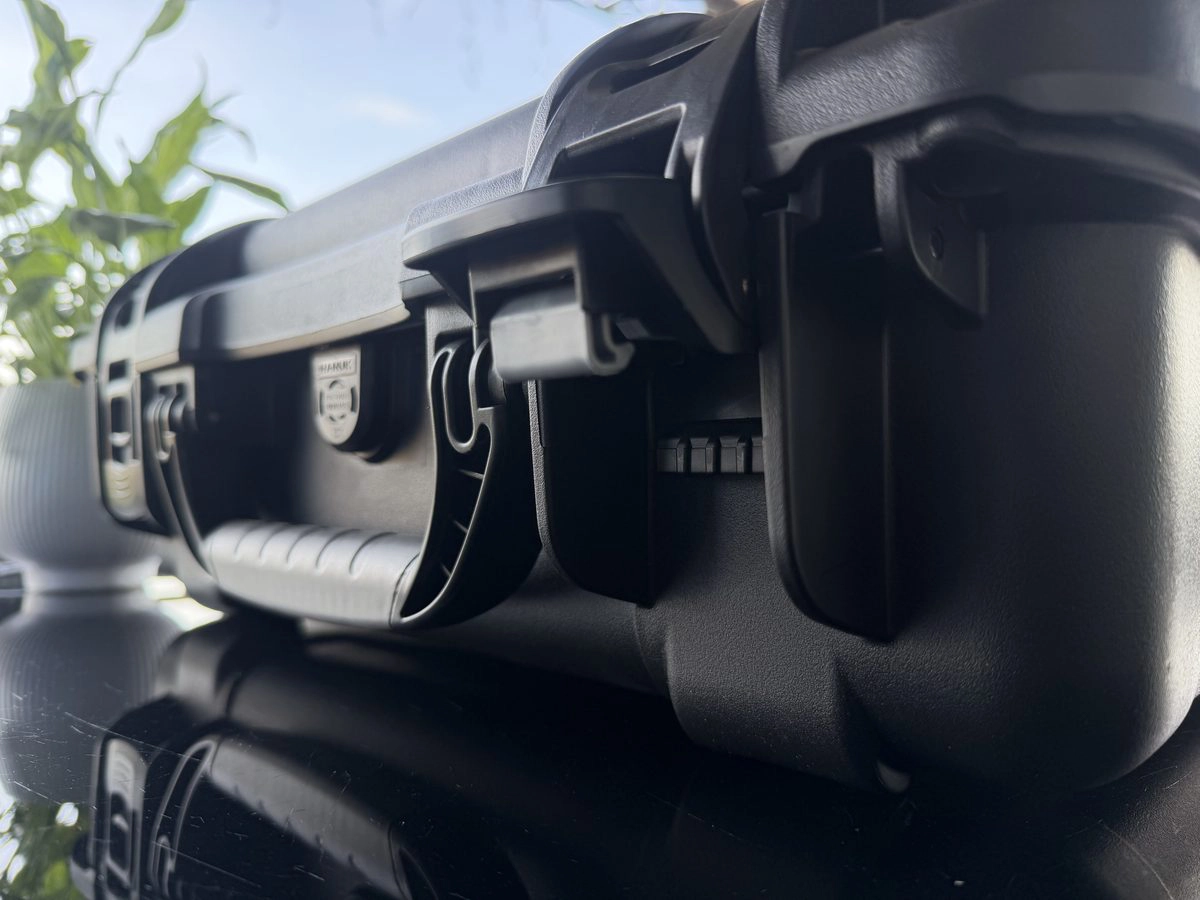
The 925 uses Nanuk’s PowerClaw latch system, and these deserve specific attention because they are meaningfully better than what you find on comparable cases at a lower price point.
The engagement action is positive and deliberate — the latch clicks into its locked position with a tactile and audible confirmation that is distinct from the soft, ambiguous feel of lesser mechanisms. There is no question about whether the case is latched. You know. This matters operationally: when you are breaking down at the end of a field day and loading equipment into a vehicle, you want that confirmation without having to visually check each latch.
The release action is equally considered. The latch requires a deliberate two-step motion to open — lift and pull — which prevents inadvertent opening from bumps or contact with other equipment. It is not a latch that opens by accident. Each latch body also incorporates a padlock hasp: a small integrated loop that accepts a standard 4–5 mm shackle. Nanuk sells their own TSA-approved combination locks designed specifically for these holes. For airport transit, equipment storage, or any situation where the case contents represent significant value, the lock point is genuinely useful rather than cosmetic.
3. Shell and exterior profile
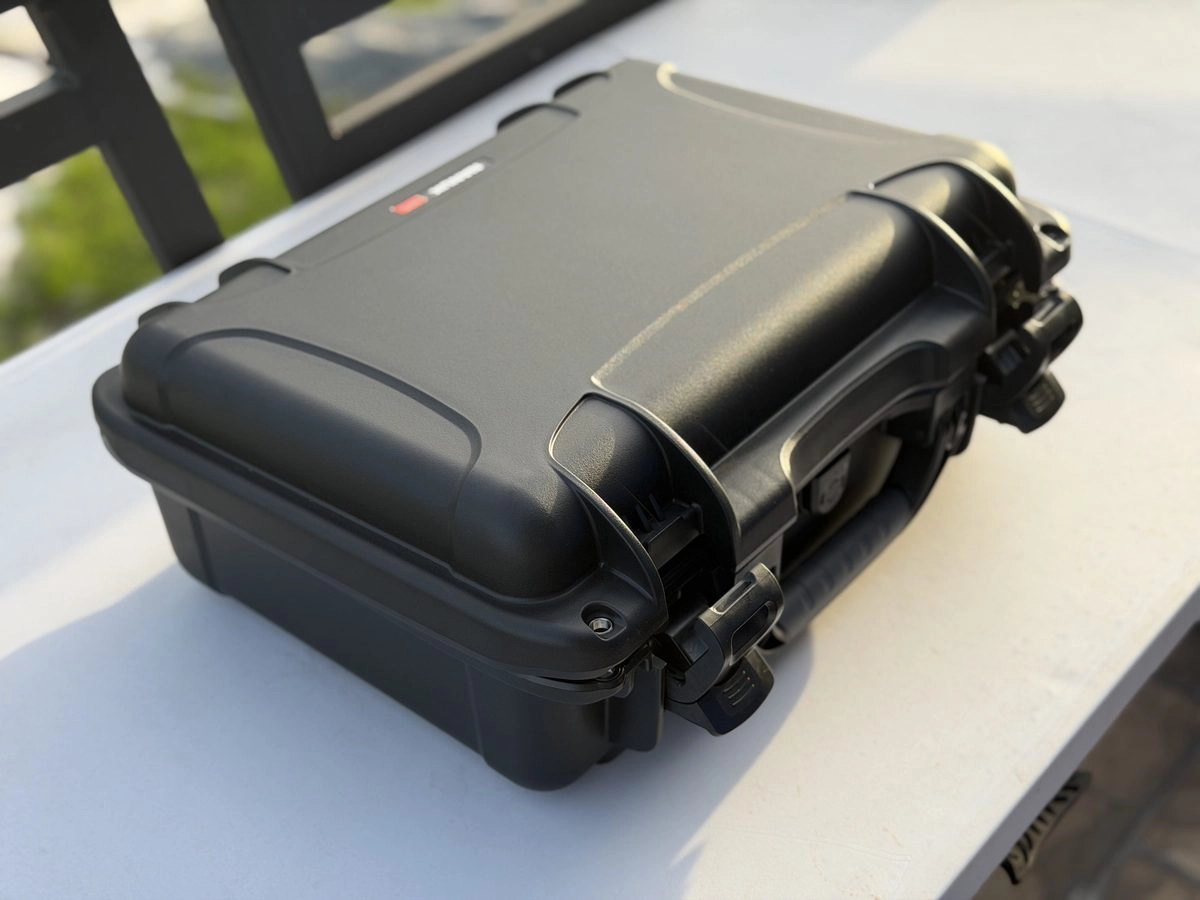
The 925 carries its size well. It does not look like a case that has been scaled up from a smaller template — the proportions are resolved, the handle placement is correct, and the lid curvature follows the body geometry consistently. The Nanuk 925 badge on the front face is restrained: a small embossed nameplate, not a large printed logo. For a case that will be handled in professional environments, that restraint is appropriate.
The recessed grip handle on the top is a single-piece moulding, not a separately attached strap. It sits flat when not in use and provides a comfortable grip for one-handed carry up to the case’s practical weight capacity. The base of the case has four rubber feet that provide stability on flat surfaces and prevent the case from sliding on smooth surfaces in the back of a vehicle.
4. The lid mechanism — two-stage close
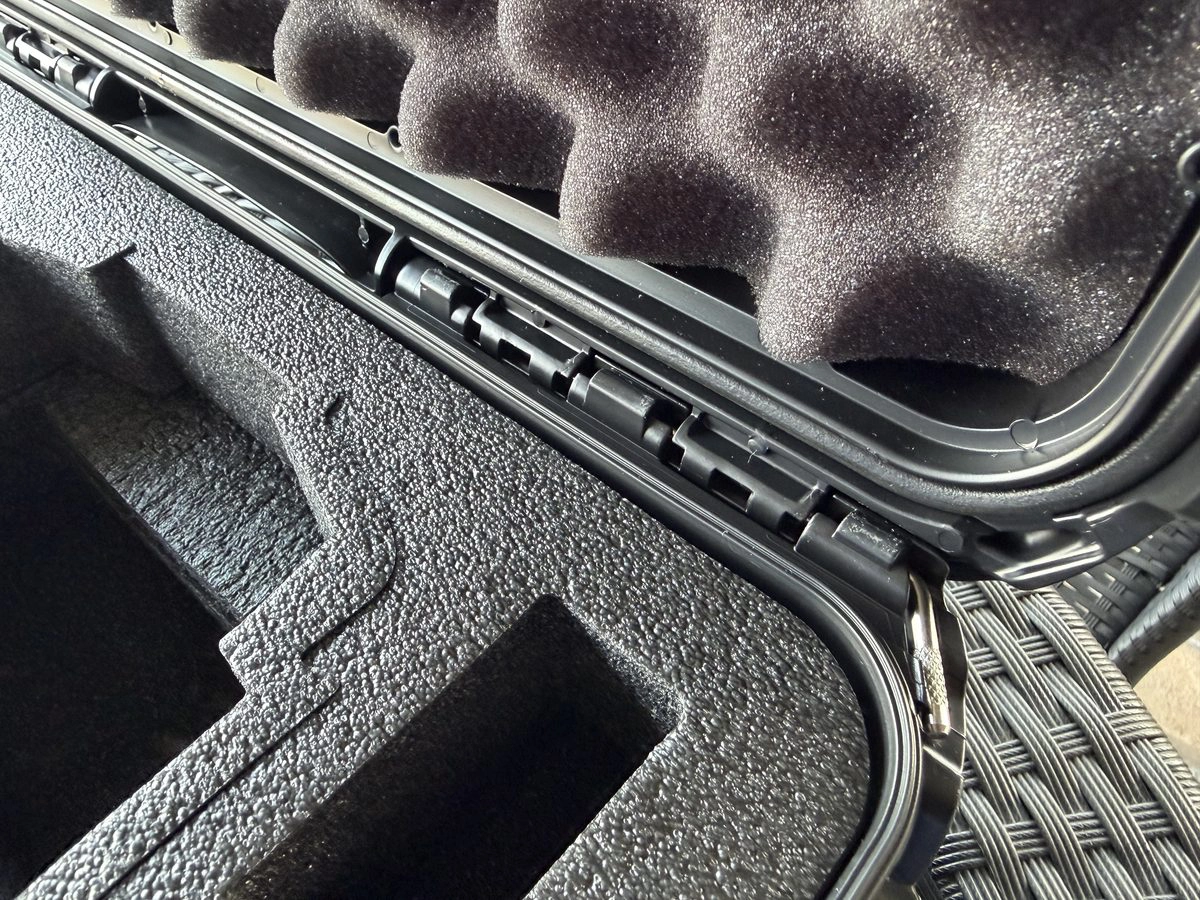
The hinge and lid mechanism on the 925 is where Nanuk has done genuinely thoughtful engineering for the use case. The lid incorporates a two-stage open-and-close behaviour: it opens freely to a first stop position, then requires deliberate additional pressure to reach full open. On the close side, the mechanism prevents the lid from falling shut under its own weight — it holds at a partially-open position until you consciously complete the closure. The intent is clear: prevent the lid from slamming down onto equipment that may be protruding from the foam cutouts during pack-down.
In the majority of use cases, this works exactly as intended. I have found it particularly useful when loading the drone body, where the gimbal and propeller arms can extend above the foam line momentarily during placement. The lid staying open removes the risk of contact during that transition.
The lid spring mechanism that provides the two-stage close also creates a meaningful rebound force when the closure does not complete. On one occasion, working with the case positioned close to the edge of a table, my grip slipped during closing before the latches engaged. The spring rebound was enough to tip the case toward the table edge — more dramatically than I expected for a mechanism of this type.
This is not a design flaw — it is a consequence of the same spring energy that gives the lid its self-holding behaviour. The practical lesson: ensure the case has stable, central positioning when closing, particularly when working at height. Keep it away from table edges during pack-down.
The hinge itself is a continuous piano-type hinge running most of the lid’s rear edge length. It is not a pair of discrete point hinges. The continuous format distributes load across the full width of the lid, preventing the torque concentration that causes discrete hinges to loosen over time. The hinge knuckles are a hybrid construction — plastic hinge bodies running on a metal pin rod — a configuration that gives excellent corrosion resistance while maintaining dimensional stability over temperature cycles. After repeated use in tropical heat, there is no discernible loosening or change in feel.
5. Interior foam — material and precision
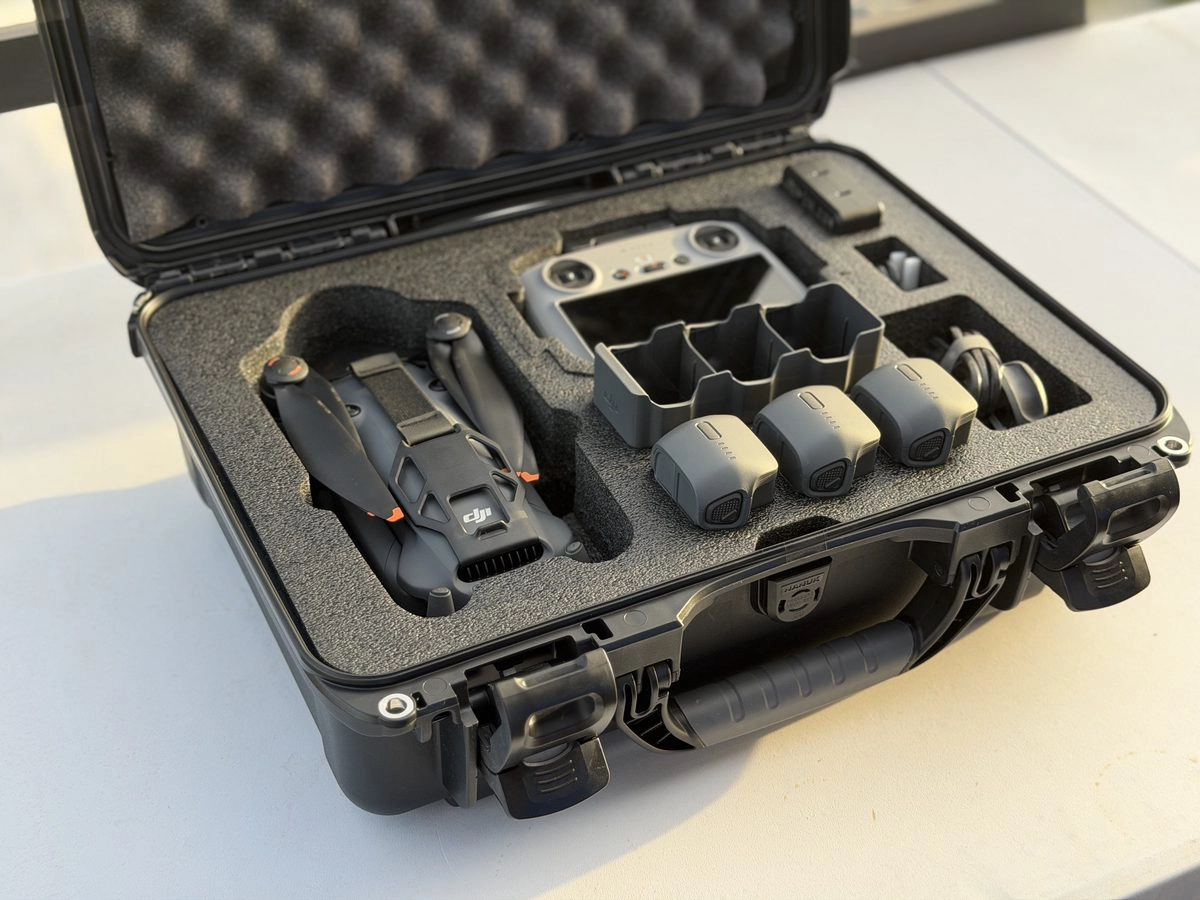
The foam work in the 925’s Fly More insert is the interior highlight. The complete DJI Mavic 4 Pro Fly More kit — folded drone body, RC 2 controller, three Intelligent Flight Batteries, charging hub, and assorted cables — occupies the base tray in a layout that appears simple until you examine the tolerances. Every component seats with zero lateral play. Not “tight fit” with effort — zero play. The components drop in cleanly and sit without movement.
This level of precision in foam cutting requires either exceptional manual craftsmanship or high-quality CNC water-jet or die-cutting. The cut walls are clean and perpendicular; there is no tearing or compression damage at the cut faces. The cell structure of the foam is consistent throughout, which matters for long-term performance: lower-density foams develop compression set over time and lose their retention properties. The Nanuk foam does not feel like it will.
Foam material specifics
The base tray foam is a closed-cell polyethylene foam — specifically, the type used in professional equipment cases for its combination of rigidity, resilience, and chemical resistance. Closed-cell construction means individual cells are sealed: moisture, dust, and chemical contaminants cannot wick through the foam matrix. This is the correct material choice for equipment that will be transported in humid, dusty, or wet conditions.
The lid foam is a separate layer of open-cell convoluted foam — the “egg crate” profile visible in Figure 4. This serves a different function from the base tray foam: it provides compliant contact across irregular surface geometries while distributing clamping force evenly. The convoluted profile also creates a degree of ventilation against the equipment surfaces, preventing moisture entrapment on extended storage. Open-cell lid foam against closed-cell base tray foam is not an arbitrary combination; it is the standard configuration in properly designed hard cases for exactly these reasons.
The AirTag opportunity
The foam interior creates a practical security opportunity worth noting explicitly. Cutting a small, shallow recess into one of the base foam panels — in a location not visible during normal use, such as beneath a battery or behind the cable tray — creates an undetectable location for an Apple AirTag or Samsung SmartTag. At the foam’s density, a clean cut with a sharp blade produces a pocket that holds a tracker firmly without movement while remaining invisible to a visual inspection of the case interior.
For a case carrying $5,000+ of drone equipment, the cost of a tracker relative to the recovery value it potentially enables is straightforward to justify. For operators who transit through airports, work on sites with general access, or charter equipment to remote locations, this is not a paranoid precaution — it is rational asset management. The Nanuk 925’s foam is deep enough and the layout complex enough that a tracker pocket is genuinely inconspicuous.
6. The pressure equaliser valve
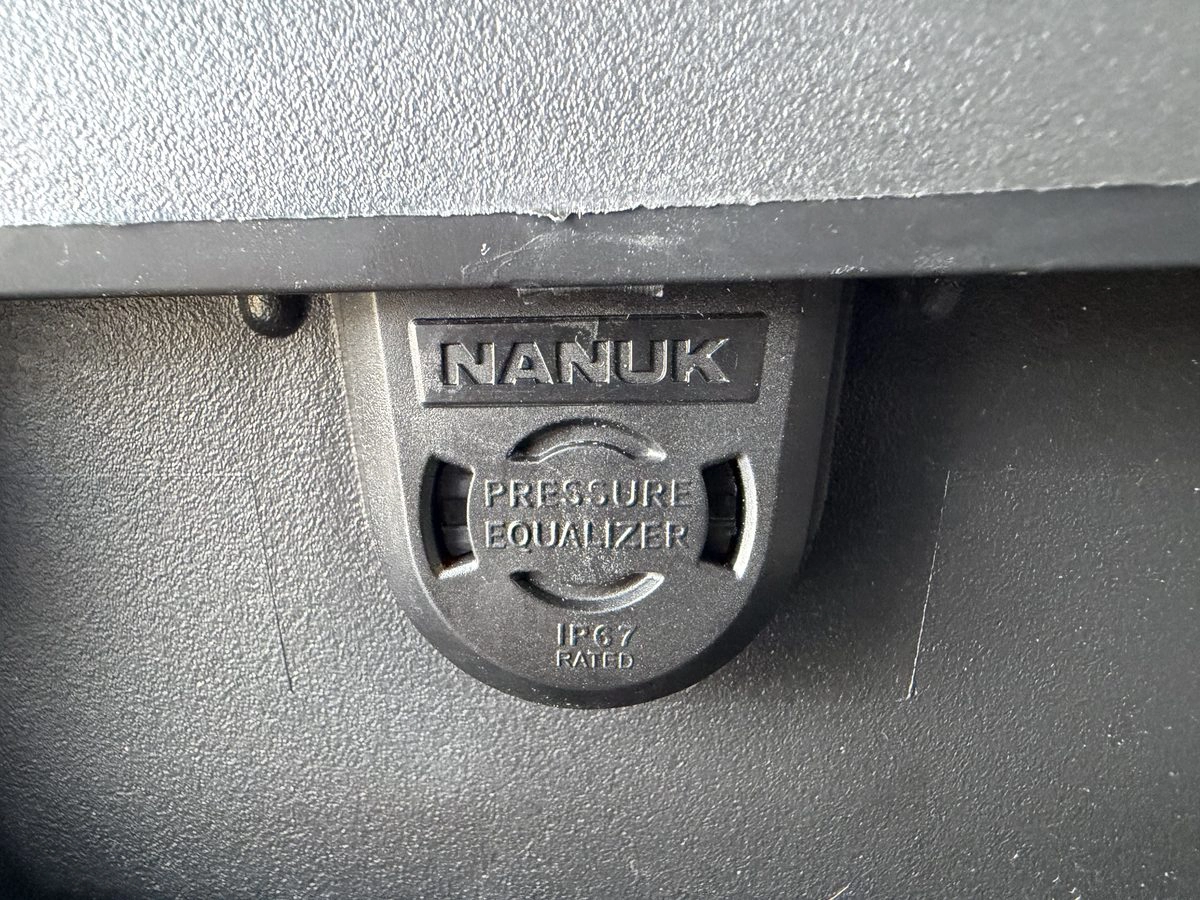
The pressure equaliser valve is one of those components that you might overlook on a spec sheet but that does genuine work in field conditions. It is embossed “IP67 RATED” — not the case overall, but the valve specifically, which matters because a valve is the potential weak point in any waterproof case enclosure.
The functional core of the valve is a Gore-Tex membrane behind the circumferential vent slots. Gore-Tex in this application is a microporous PTFE membrane: the pore geometry (approximately 0.2 μm) is smaller than water droplets but larger than water vapour and air molecules. This means the membrane allows gas exchange while blocking liquid water entry in both directions — it is a one-way barrier only in the sense that water cannot pass while air can.
Why does this matter? Two reasons. First, altitude change. A case sealed at sea level contains air at sea-level pressure. At cruising altitude in an aircraft hold — or at 3,000 m on an Andean mining site — the external pressure drops. Without equalisation, the case interior becomes a mild pressure vessel, making the latches harder to open and stressing the seal over repeated cycles. The valve bleeds this differential passively. Second, and more practically for tropical operations: temperature cycling. A case left in a hot vehicle develops elevated internal pressure as the air inside heats. The valve equalises this passively and continuously, preventing the seal from working against a pressure differential every time it is opened.
The IP67 rating on the case overall means it is rated for immersion to 1 m for 30 minutes. For most field operations this is overspecification — but it means the case handles rain, boat spray, and the kind of incidental moisture exposure that is routine in tropical survey work without any thought required on the operator’s part.
7. Key specifications
| Parameter | Specification |
|---|---|
| External dimensions | 394 × 296 × 151 mm (15.5 × 11.7 × 5.9 in) |
| Internal dimensions | 356 × 250 × 127 mm (14.0 × 9.8 × 5.0 in) |
| Shell material | NK-7 high-impact polypropylene copolymer |
| Waterproof rating | IP67 (1 m immersion, 30 min) |
| Pressure equaliser | Gore-Tex PTFE membrane, IP67 rated |
| Latch system | Nanuk PowerClaw, with padlock hasp |
| Hinge construction | Continuous piano hinge, plastic body on metal pin |
| Foam (base) | Closed-cell polyethylene, precision CNC cut |
| Foam (lid) | Open-cell convoluted polyethylene |
| Empty weight | ~2.0 kg (4.4 lbs) |
| Temperature range | −33 °C to +99 °C (−27 °F to +210 °F) |
| Airline carry-on | Yes (compliant with standard carry-on dimensions) |
| Lock compatibility | Standard 4–5 mm shackle; Nanuk combo lock (sold separately) |
| Colours available | Black, graphite, olive, tan, orange, yellow, white |
8. Field operator scorecard
| Category | Score | Operator notes |
|---|---|---|
| Shell material quality | ★★★★★ | NK-7 is meaningfully better than commodity ABS in rigidity and impact response |
| Latch feel and security | ★★★★★ | Positive engagement, no ambiguity, lock holes are a genuine addition |
| Hinge durability | ★★★★★ | Continuous piano hinge is the correct engineering choice for longevity |
| Foam precision | ★★★★★ | Zero-play fit on all components; cut quality is production-grade |
| Lid mechanism | ★★★★☆ | Two-stage close is excellent in concept; spring rebound warrants care near table edges |
| Pressure equaliser | ★★★★★ | Gore-Tex membrane does real work in tropical temperature-cycling conditions |
| Water and dust protection | ★★★★★ | IP67 is appropriate overspecification for field use |
| Carry-on portability | ★★★★★ | Compliant dimensions, manageable weight, suitable for charter and commercial aircraft |
| Value | ★★★★☆ | Standalone purchase commands a premium; bundled with Fly More kit, the value calculation is excellent |
9. The case for Nanuk on any drone without a dedicated case
DJI’s consumer and prosumer drones — Mini series, Air series, the standard Mavic line — typically ship in soft carry bags or moulded plastic trays that are adequate for home storage and inadequate for field transport. The soft bag that comes with a Mavic Air 2S is not a case you want to rely on when the drone is in the back of a 4WD on a dirt road, checked into a cargo hold, or handed to a boat operator for river transit.
Nanuk offers pre-cut foam inserts for a wide range of DJI and other drone models across their case lineup. The configuration reviewed here — the 925 with Mavic 4 Pro Fly More insert — is the top of the range for compact drones. For anyone running a Mini 4 Pro, Air 3, or Air 3S without an appropriate hard case, the Nanuk 925 or the smaller 910/915 with appropriate inserts addresses that gap with equipment that is demonstrably fit for professional field use.
For commercial operators specifically: a case that survives charter flights, provides TSA-lockable security, and has the IP67 rating to handle field conditions is not optional equipment. It is part of the professional kit. The Nanuk range is the correct answer to that requirement.
10. Where to buy
The Nanuk 925 is the hard case benchmark for compact professional drones. The latch system, foam precision, hinge engineering, and pressure equaliser valve all reflect deliberate design decisions rather than specification padding. The two-stage lid mechanism has one real-world caveat worth knowing. Everything else is excellent.
If your drone came without a hard case — or came with something that is not one — the Nanuk 925 is the correct answer for anything in the compact-to-mid-size category. Buy it with the locks.
Final thoughts
I did not intend to review this case. It came in the box. What made me want to was the moment I first latched it closed — the deliberate, mechanical click of the PowerClaw engaging is the sound of something built to outlast the equipment it protects. Reviewing equipment on this site means reviewing things that earn it, not things that were sent to be reviewed. The 925 earned it.
One last image. My kid found out the case was being photographed.